For proof of income and financial need for scholarship applications, start by checking the scholarship’s exact requirement. The right document usually depends on how you, your parent, your guardian, or your spouse earns income.
If you or your parent is employed, you may need BIR Form 2316 or a Certificate of Employment with Compensation.
If you’re self-employed or running a business, an Income Tax Return like BIR Form 1701 may apply.
If your family has low or no income, you may instead be able to use a BIR certificate, Certificate of Indigency, or social welfare document.
You don’t need all the documents in this guide, just the one required or accepted for your situation.
Overview
Who might need Proof of Income and Financial Need for Scholarship Applications?
You may need one of these documents if your scholarship asks for proof of family income or financial need, and any of the following apply to you:
- You, your parent, or your guardian is employed
- You, your parent, or your guardian is self-employed or runs a business
- You, your parent, or your guardian has low income or no regular income
- Your program accepts a Certificate of Indigency
- Your program asks for a social welfare certificate or case study
- You, your parent, or your guardian is an OFW or seafarer
- You, your parent, or your guardian receives a pension
- Your program asks for a specific BIR income, exemption, or non-filing certificate
Some programs also let you use your own income documents, if the rules allow it. CHED BPMSP, for example, refers to the income documents of both parents or legal guardians or of the applicant depending on which option you’re using.
There’s no single proof-of-income document used by every Philippine scholarship. Current CHED and DOST-SEI requirements use different documents for different income situations, so it really does come down to your own case.
What is Proof of Income and Financial Need for Scholarship Applications?
Proof of income is a document that shows income, salary, compensation, pension, or another source of earnings.
Proof of financial need is a bit broader. Some scholarship programs also accept documents showing that your family has low income, no income, indigency, or has gone through a social welfare assessment.
Proof of Income vs. Proof of Financial Need at a Glance
| Type | What it generally shows |
|---|---|
| Proof of income | Salary, business income, taxable income, pension, contract income, or another source of earnings |
| Proof of financial need | Low income, no income, indigency, 4Ps status, or a social welfare review where accepted |
CHED BPMSP illustrates the difference well. Its accepted options include tax records, a BIR tax exemption/non-filer certificate, a social welfare certificate for qualifying 4Ps beneficiaries, and OFW or seafarer income proof.
Across the current scholarship requirements reviewed for this guide, you might come across these nine broad document types:
- Income Tax Return, including BIR Form 1701 for those it applies to
- BIR Form 2316
- Certificate of Employment with Compensation
- BIR Certificate of Tax Exemption / Non-Filer
- BIR Certificate of No Income / Low Income
- Certificate of Indigency
- Social Welfare Certificate / Case Study
- OFW or Seafarer Employment Contract / Proof of Income
- Proof of Pension
Again, this isn’t a checklist of nine documents you need to submit. These are just the options found across different scholarship programs and family situations.
What kind of proof of income do you actually need?
Start with the income situation of the person whose finances the scholarship is asking about.
| Your situation | Document you may need |
|---|---|
| Self-employed, professional, business owner, or other ITR filer | ITR / BIR Form 1701, for those it applies to |
| Salaried employee | BIR Form 2316 |
| Employer-certified income is required | Certificate of Employment with Compensation |
| Low/no income and BIR exemption is accepted | BIR Certificate of Exemption / Non-Filer |
| Program specifically names BIR No Income / Low Income | BIR certificate named by the program |
| Indigency is accepted | Certificate of Indigency |
| Social welfare review is required | Social Welfare Certificate / Case Study |
| You (or your parent/guardian) are an OFW or seafarer | Contract / Proof of Income |
| You (or your parent/guardian) receive a pension | Proof of Pension |
Think of this table as a starting point, not the final word your scholarship’s actual requirement is still what controls what you should submit.
If an Income Tax Return or BIR Form 1701 applies to you
BIR Form 1701 is an annual income tax return used by people engaged in trade or business, the practice of a profession, and certain mixed-income situations. It’s not the ITR form for every taxpayer, so don’t assume it’s yours by default.
Example: CHED BPMSP accepts the latest Annual Income Tax Return or BIR Form 1701 as one of its proof-of-income options.
What to do: Use the filed return for the person and tax year your scholarship requires.
If BIR Form 2316 applies to you
BIR Form 2316 is the Certificate of Compensation Payment/Tax Withheld for Compensation Payment With or Without Tax Withheld. Employers issue this to covered employees.
Example: CHED BPMSP accepts BIR Form 2316 as one of its proof-of-income options.
What to do: Get the correct Form 2316 from your employer, and double-check it covers the year your program requires.
If a Certificate of Employment with Compensation applies to you
This is an employer-issued certificate that includes both employment and salary information.
DOST-SEI currently lists Certificate of Employment with Compensation for cases where it’s needed.
What to do: If your scholarship says “with Compensation,” make sure you request a certificate that actually includes salary details not just a basic COE confirming employment.
If a BIR Certificate of Tax Exemption or Non-Filer applies to you
CHED BPMSP currently accepts a Certificate of Tax Exemption/Non-Filer issued by BIR as one of its proof-of-income options.
BIR also has a specific service for people with low or no income who need a Certificate of Exemption for Scholarship and Job/Livelihood Programs.
What to do: Bring your scholarship’s exact wording when you deal with BIR, so the RDO can confirm which certificate or service actually applies to you.
If a BIR Certificate of No Income or Low Income applies to you
CHED CoScho currently lists both a Certificate of No Income from BIR and a Certificate of Low Income from BIR (indicating the actual amount of income).
That said, BIR’s current public Citizen’s Charter lists its scholarship service as Processing of Application for Certificate of Exemption for Scholarship and Job/Livelihood Programs. A separate nationwide public procedure under the exact “Certificate of No Income” or “Certificate of Low Income” titles wasn’t found while researching this guide.
What to do: Bring your scholarship’s exact wording to your BIR RDO and ask which current certification satisfies it.
If a Certificate of Indigency applies to you
Some scholarship programs accept a Certificate of Indigency for qualifying low-income situations. DOST-SEI currently includes it among its income-document options.
The issuing process varies from one local office to another. A 2026 DILG legal opinion also specifically addresses how Certificates of Indigency should be issued.
What to do: Follow the issuer named or accepted by your scholarship.
If a Social Welfare Certificate or Case Study applies to you
CHED CoScho currently accepts a Certificate/Case Study from the City/Municipal Social Welfare and Development Office. BPMSP separately accepts a DSWD or C/MSWD certificate for qualifying 4Ps beneficiaries.
What to do: Follow the exact document and office named by your program.
If an OFW or Seafarer Employment Contract or Proof of Income applies to you
CHED BPMSP currently accepts a Certified True Copy of the latest contract or proof of income for children of OFWs and seafarers.
What to do: Use the latest employment document that fits your situation, and follow any Certified True Copy requirement your scholarship states.
If Proof of Pension applies to you
DOST-SEI currently lists Proof of Pension for parent or guardian situations where it applies, though there isn’t one single nationwide document called a “Pension Statement.”
What to do: Check what pension record your scholarship accepts, then request that specific record from the pension provider.
Where do you get these documents?
Where you start depends entirely on which document you need.
| Document | Where to start |
|---|---|
| ITR / BIR Form 1701 | Your filed tax records; BIR RDO if certification is needed |
| BIR Form 2316 | Your employer, HR, or payroll |
| Certificate of Employment with Compensation | Your employer, HR, or payroll |
| BIR Certificate of Exemption | Your appropriate BIR Revenue District Office |
| BIR No Income / Low Income document | Confirm with your appropriate BIR RDO |
| Certificate of Indigency | Barangay or social welfare office accepted by your scholarship |
| Social Welfare Certificate / Case Study | DSWD, CSWDO, or MSWDO named or accepted by your program |
| OFW / Seafarer Contract or Proof of Income | The worker, employer, recruitment/manning agency, or the right DMW/MWO service |
| Proof of Pension | Your pension provider, such as GSIS, SSS, or another provider that fits your case |
For BIR’s scholarship Certificate of Exemption service, the published procedure directs you to the RDO that covers the taxpayer’s home address or place of registration.
What are the requirements for these documents?
There are actually two separate requirements you’ll need to keep in mind here.
What does your scholarship provider want?
Before you request anything, check:
- Whose income needs to be shown
- The exact document accepted
- The tax year or income period required
- Whether documents from both parents or guardians are needed
- Whether another document is allowed for low or no income
- Whether a Certified True Copy is required
- Whether your scholarship wants an original, photocopy, or uploaded file
For example, CHED BPMSP asks applicants for one of its listed proof-of-income options. Its Form 1701/Form 2316 option refers to both parents or legal guardians or the applicant, whichever fits your case.
What does the issuing office need from you?
This depends on the document.
Employer-issued records follow your employer’s own procedure. Barangay and social welfare requirements vary by local office. Pension records follow the procedure of your pension provider.
For BIR’s low/no-income scholarship Certificate of Exemption service, the published requirements include an original Certification of Low Income/No Income signed by the Barangay Chairman where you reside, plus an original duly notarized Affidavit of Low Income/No Income.
Just keep in mind: the Affidavit of Low Income/No Income is something you prepare and submit to BIR, it isn’t issued by BIR itself.
How do you actually get the document you need?
The nine document types don’t all follow the same process, so it helps to treat each one separately.
Some records may already exist for you, like an ITR, Form 2316, employment contract, or pension record. Others need to be requested from an employer, BIR, a barangay, or a social welfare office.
Here’s how to go about getting each one.
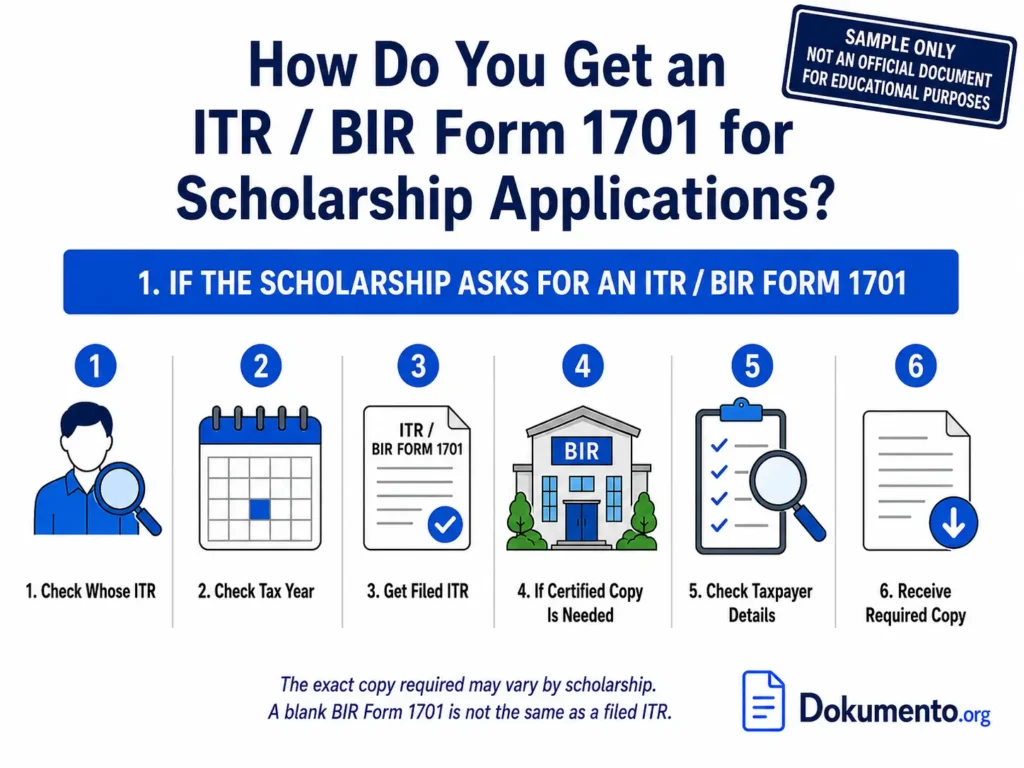
If your scholarship asks for an Income Tax Return or BIR Form 1701
- Check whose ITR your scholarship requires.
- Check the tax year or income period required.
- Look for the filed ITR in your records.
- If a BIR-certified or manually stamped copy is needed, contact your RDO and ask about the current certification procedure.
- Bring the filed return and proof of electronic filing, when BIR requires it.
- Receive the certified or stamped copy and check the taxpayer name and tax year.
A 2026 BIR FOI response notes that for Form 1701 or 1701A, if you’re requesting manual stamping, bring the original and a photocopy of the return along with the eBIRForms Confirmation Receipt or eFPS Filing Reference Number, if you have one.
Important: A blank copy of BIR Form 1701 isn’t the same as your filed ITR.
After you get it: Follow your scholarship’s instructions on whether it needs an original, photocopy, Certified True Copy, or uploaded file.
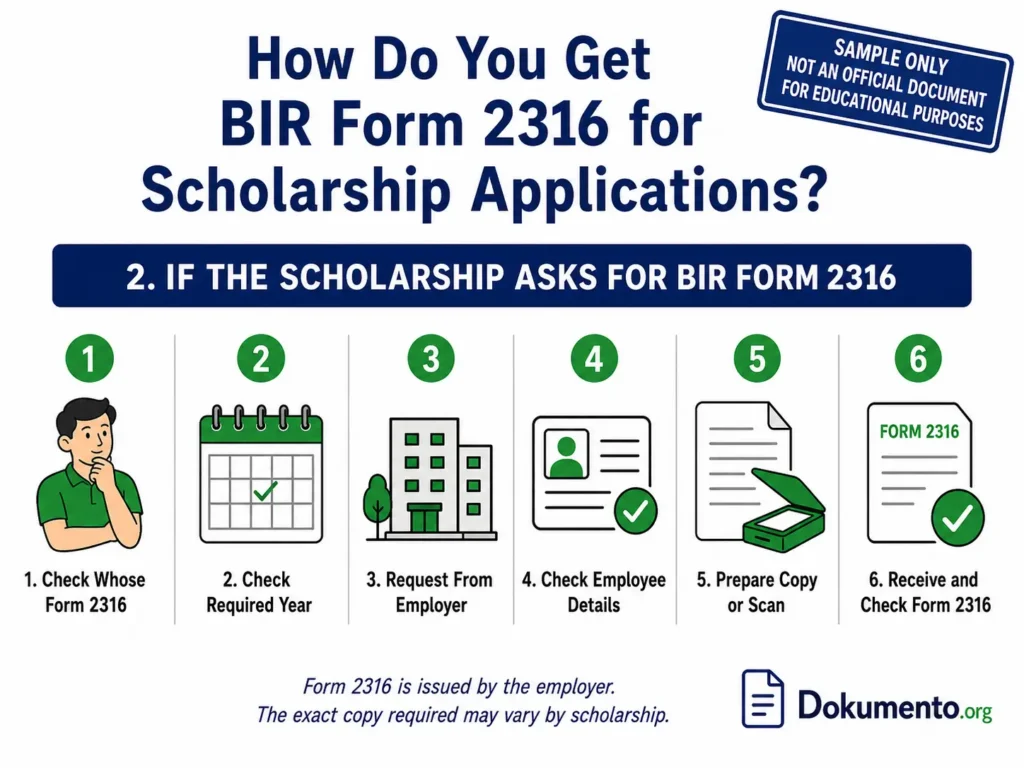
If your scholarship asks for BIR Form 2316
- Check whose Form 2316 is required.
- Check the year required.
- Contact the employee’s employer, HR office, or payroll office.
- Ask for the correct BIR Form 2316.
- Receive the form.
- Check the employee’s name, year, and salary information.
BIR requires employers to give Form 2316 to employees on or before January 31 of the following calendar year. If employment ends before the year is over, the employer should provide it on the employee’s last pay date.
After you get it: Prepare the copy or scan your scholarship requires.
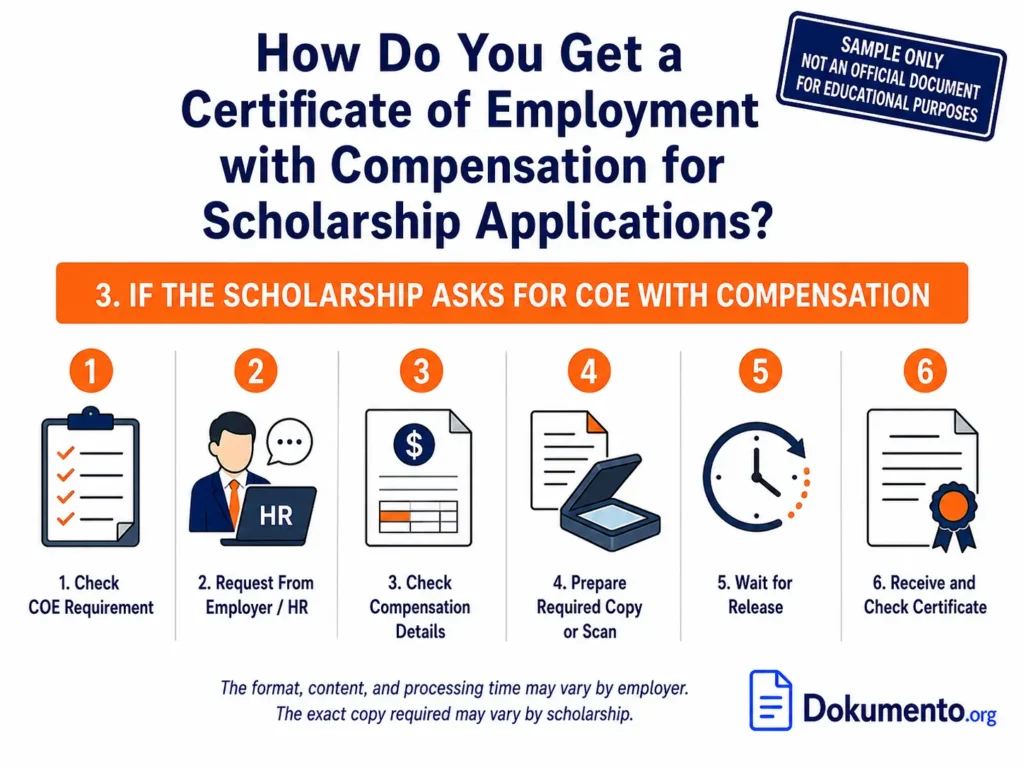
If your scholarship asks for a Certificate of Employment with Compensation
- Read the exact document name in your scholarship requirement.
- Contact the employer, HR office, or payroll office.
- Request a Certificate of Employment with Compensation.
- Make it clear that salary information needs to be included.
- Receive the certificate.
- Check the employee’s name, employment details, and salary information.
DOLE states that a Certificate of Employment should be issued within three days of the employee’s request. That’s the general COE rule if your scholarship specifically requires salary information, be clear about that when you make your request.
After you get it: Prepare the copy or scan your scholarship requires.
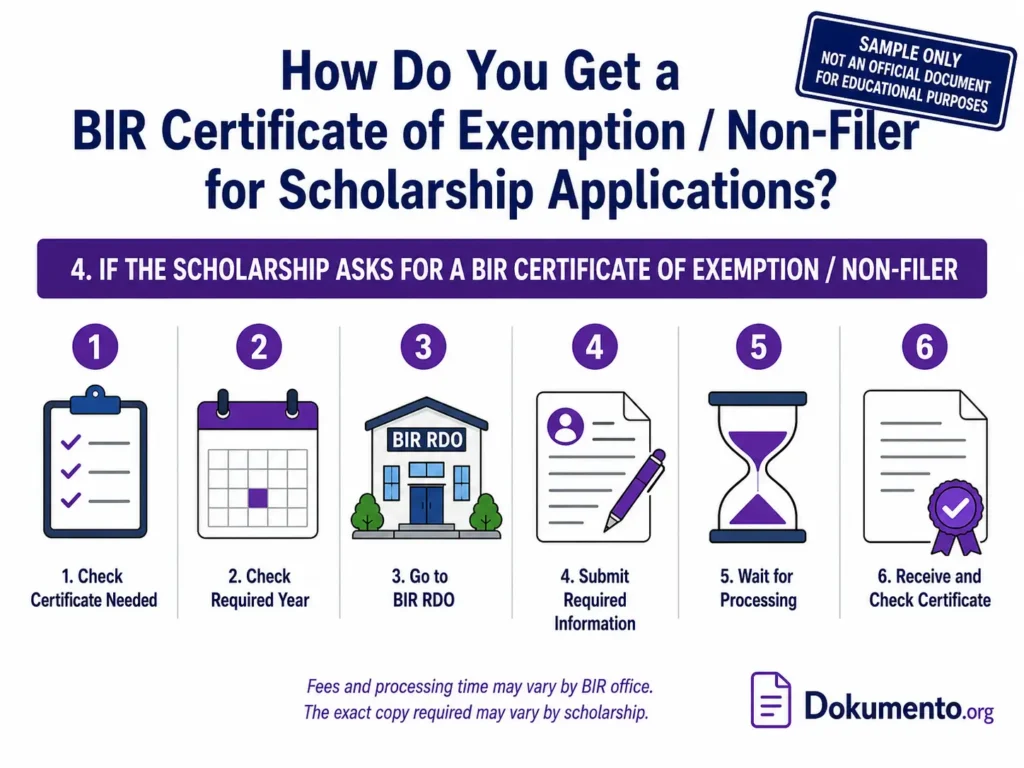
If your scholarship asks for a BIR Certificate of Tax Exemption or Non-Filer
For BIR’s published low/no-income scholarship Certificate of Exemption service:
- Confirm that this service matches your scholarship requirement.
- Get the required Certification of Low Income/No Income from your barangay.
- Prepare the Affidavit of Low Income/No Income and have it notarized.
- Go to your appropriate BIR Revenue District Office.
- Submit the required documents.
- Complete the BIR interview and let the RDO review your documents.
- Pay the ₱30 loose Documentary Stamp Tax.
- Wait for the certificate to be prepared and approved.
- Receive and check the certificate.
BIR provides this service for people with low or no income who need a certificate for scholarship or job/livelihood programs.
Under BIR Revenue Memorandum Circular No. 127-2024, the previous ₱100 certification fee was removed for qualified low/no-income applicants using this service. The ₱30 Documentary Stamp Tax still applies.
After you get it: Use the certificate in the format your scholarship requires.
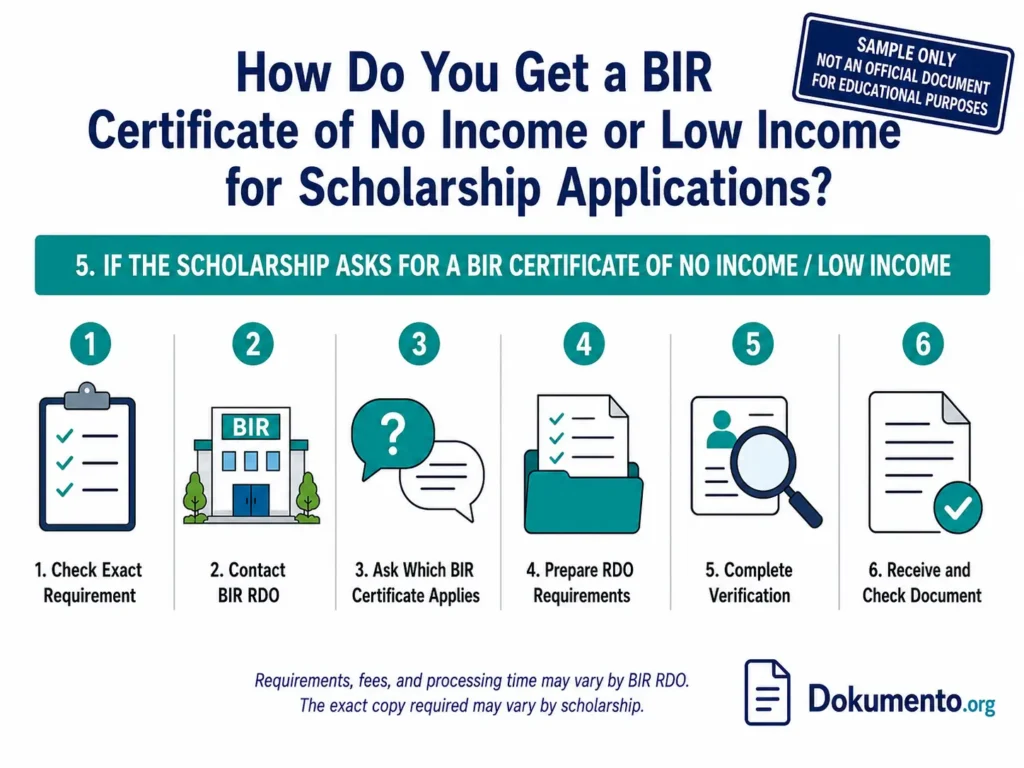
If your scholarship asks for a BIR Certificate of No Income or Low Income
- Save or print the exact wording of your scholarship requirement.
- Check whose income status needs to be certified.
- Contact or visit the BIR RDO handling that taxpayer.
- Show them the exact scholarship requirement.
- Ask which current BIR certificate or service meets it.
- Prepare whatever requirements the RDO gives you.
- Complete any required checking or review.
- Receive the BIR document.
- Check that it matches your scholarship’s requirement.
CHED CoScho currently names BIR No Income and Low Income certificates, but BIR’s current public Citizen’s Charter doesn’t publish separate nationwide procedures under those exact titles.
Because of that, it’s best not to assume the Certificate of Exemption procedure automatically applies to you.
After you get it: Follow your scholarship’s submission instructions.
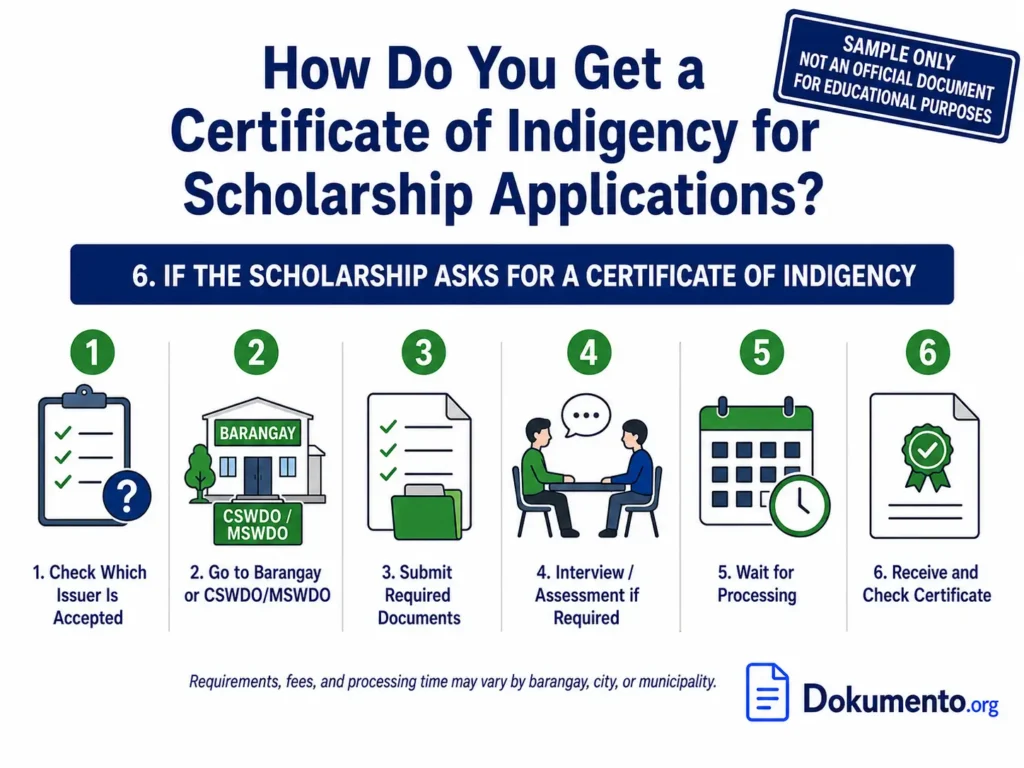
If your scholarship asks for a Certificate of Indigency
- Check which issuer your scholarship accepts.
- Go to the correct barangay or social welfare office.
- Check that office’s current requirements.
- Submit the required information and documents.
- Complete an interview or review, if required.
- Wait for the certificate to be prepared and signed.
- Receive and check the certificate.
There’s no single nationwide checklist or processing time for every Certificate of Indigency. For example, San Nicolas, Pangasinan’s MSWDO requires a valid ID and a Barangay Certificate of Indigency for its own service, and publishes a 20-minute processing time but that’s a local example, not a nationwide rule.
After you get it: Follow your scholarship’s required copy or upload format.
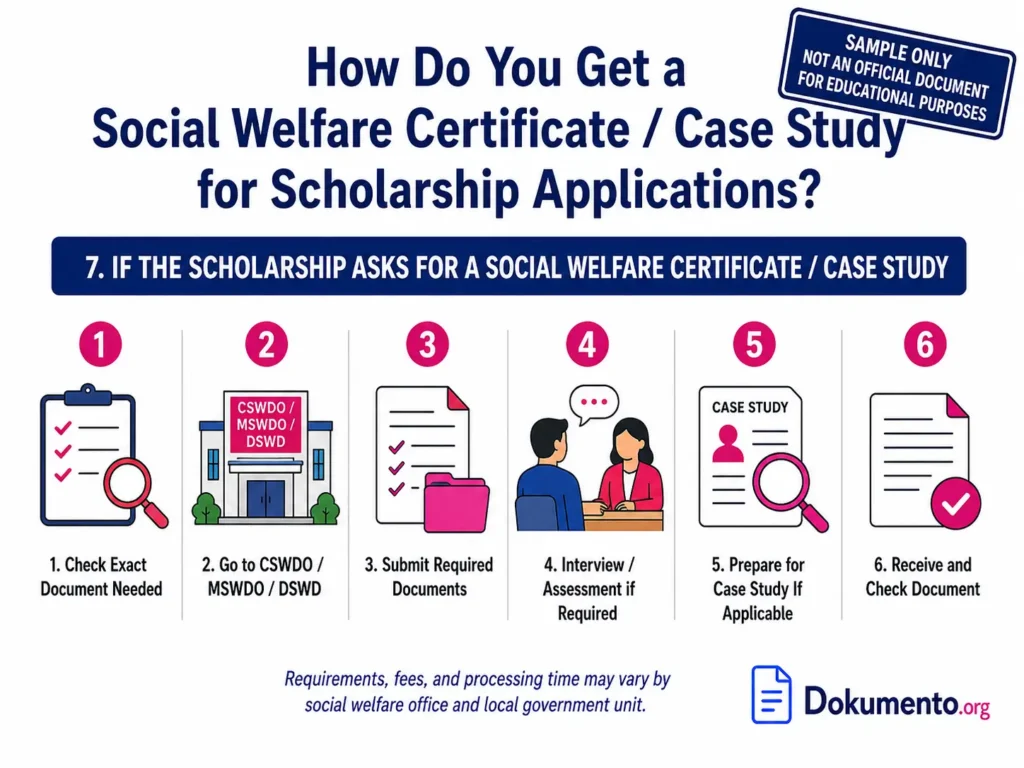
If your scholarship asks for a Social Welfare Certificate or Case Study
- Check the exact social welfare document required.
- Check whether your scholarship requires DSWD, CSWDO, or MSWDO.
- Go to the office named or accepted by your program.
- Prepare that office’s requirements.
- Request the certificate or case study.
- Complete the social worker’s interview or review.
- Cooperate with a home visit, if the office requires one.
- Wait for the report or certificate to be prepared and signed.
- Receive and check the document.
A useful example comes from San Nicolas, Pangasinan. Its MSWDO Social Case Study Report service specifically covers indigent college students applying for scholarships. The process includes checking your documents, an intake or in-depth interview, a possible home visit, preparation of the report, signing, and release.
Just keep in mind that exact requirements and review steps still vary by LGU.
After you get it: Follow your scholarship’s submission instructions.
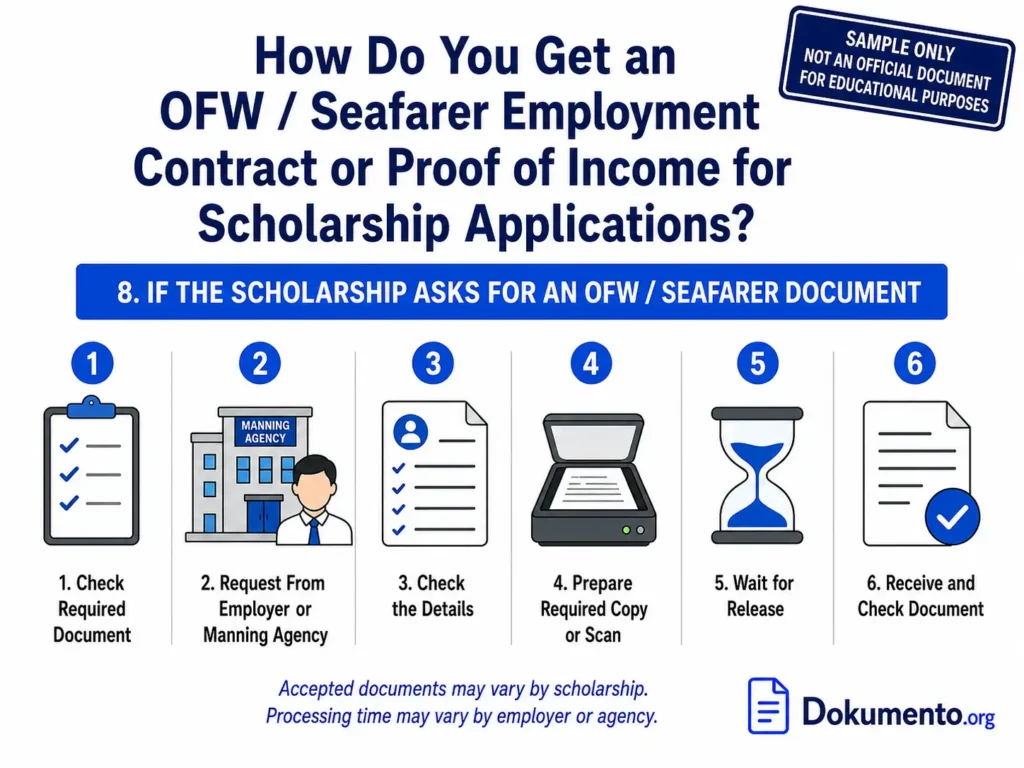
If your scholarship asks for an OFW or Seafarer Employment Contract or Proof of Income
- Check whether your scholarship requires the latest contract or another proof of income.
- Check your own records for the latest document.
- If needed, contact the employer or licensed recruitment or manning agency involved.
- Check whether your scholarship requires a Certified True Copy or verified document.
- If certification or checking is required, go through the correct DMW or Migrant Workers Office process.
- Receive the required employment record and check the worker’s name and employment details.
DMW checks and certifies OFW records, and Migrant Workers Offices also check employment contracts when required. This kind of checking isn’t automatically required for every OFW contract MWO Singapore, for instance, states that it applies in specific Balik-Manggagawa situations, such as a change in employer, job site, or position.
After you get it: Follow any Certified True Copy requirement stated by your scholarship.
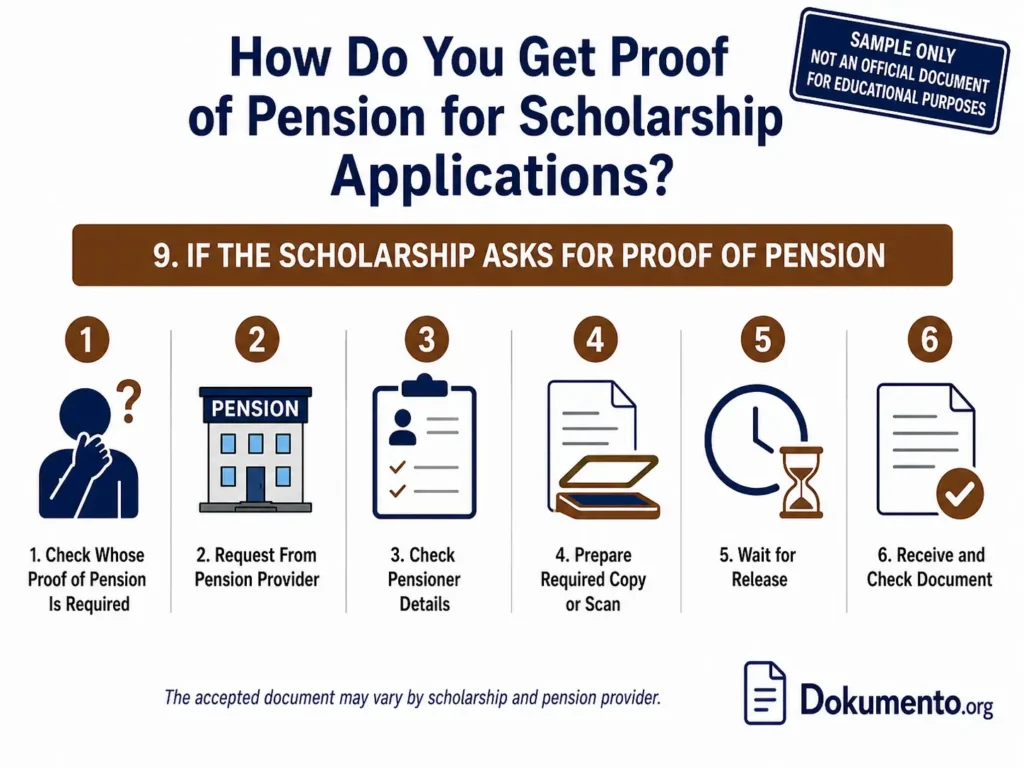
If your scholarship asks for Proof of Pension
- Check whose pension needs to be shown.
- Check whether your scholarship names a specific pension document.
- Identify the pension provider.
- Request or obtain the pension record your scholarship accepts.
- Receive the document.
- Check the pensioner’s name and pension details.
For GSIS pensioners, the official Pensioner’s Request Form includes an option to request a Certificate of Pension. (GSIS)
For SSS pensioners, SSS confirms that retirement benefits may be paid as a monthly pension but you’ll still want to confirm exactly what record your scholarship accepts, since DOST-SEI’s requirement simply says “Proof of Pension.”
After you get it: Prepare the record in the format your scholarship requires.
How long does it take to get these documents?
There’s no single processing time here, since each document comes from a different issuer.
| Document | Published or verified timing |
|---|---|
| BIR Certificate of Exemption | 6 hours and 5 minutes under BIR’s current service listing |
| Certificate of Employment | Within 3 days of your request, under the general DOLE COE rule |
| BIR Form 2316 | Issued under BIR’s rules on when employers must give it not a standard “request time” |
| Certificate of Indigency | Depends on the LGU or issuing office |
| Social Welfare Certificate / Case Study | Depends on the social welfare office |
| OFW / Seafarer record | Depends on the document and which office issues or checks it |
| Proof of Pension | Depends on the pension provider |
BIR publishes a processing time for its Certificate of Exemption service, while DOLE provides the three-day general rule for issuing a COE after your request.
For local government, social welfare, OFW, and pension documents, it’s best not to assume one nationwide processing time applies.
How much does it cost?
Again, there’s no single fee that covers all of these documents.
| Document or service | Cost information |
|---|---|
| BIR Certificate of Exemption | ₱30 Documentary Stamp Tax |
| Certification fee for the BIR low/no-income scholarship exemption service | Waived |
| BIR-certified/stamped ITR, when certification is requested | Certification fee may be up to ₱100, plus ₱30 DST, based on BIR’s 2026 FOI guidance |
| Notarized Affidavit of Low Income/No Income | Notary fee varies |
| Other documents | Depends on the issuing office |
RMC No. 127-2024 waived the ₱100 certification fee specifically for BIR’s low/no-income Certificate of Exemption used for scholarship and job/livelihood programs it didn’t waive every BIR certification fee.
For example, BIR’s April 2026 guidance on certifying an ITR states that certification may cost up to ₱100, plus ₱30 Documentary Stamp Tax.
Frequently Asked Questions
Do you need all nine documents?
No. The nine types in this guide come from different programs and income situations. CHED BPMSP itself gives you alternative proof-of-income options rather than requiring every applicant to submit all of them.
Is BIR Form 2316 the same as an ITR?
No. BIR Form 2316 is an employer-issued Certificate of Compensation Payment/Tax Withheld. BIR Form 1701 is an annual income tax return used in specific taxpayer situations.
Is a Certificate of Employment the same as BIR Form 2316?
No. A Certificate of Employment is an employer-issued employment record, while BIR Form 2316 is a specific BIR tax certificate. DOST-SEI treats Certificate of Employment with Compensation as one possible income document among others.
What if your parent or guardian doesn’t have an ITR?
Use the alternatives your scholarship allows. Current programs may accept a BIR exemption/non-filer certificate, Certificate of Indigency, social welfare document, or another proof that fits your case.
Is the Affidavit of Low Income/No Income issued by BIR?
No. You prepare it yourself and have it notarized, then submit it to BIR as part of your Certificate of Exemption application.
Is the barangay Low Income/No Income Certification enough on its own?
Not for the BIR Certificate of Exemption process covered here. BIR’s published requirements also call for a duly notarized Affidavit of Low Income/No Income.
What if your scholarship says “Certificate of No Income from BIR”?
Use that exact wording when you speak with your BIR RDO. CHED CoScho currently names a Certificate of No Income from BIR, while BIR’s published nationwide scholarship service is titled Certificate of Exemption for Scholarship and Job/Livelihood Programs.
What if one parent is employed and the other has no income?
Your scholarship may require different proof for each person. CHED BPMSP’s Form 1701/Form 2316 option refers to both parents or legal guardians, while its other accepted options cover different situations, so it’s worth following your specific program’s instructions rather than assuming one parent’s record covers both.
Can a Certificate of Indigency replace an ITR?
Only if your scholarship accepts it. DOST-SEI includes a Certificate of Indigency for qualifying situations, while other scholarship programs use different income-document lists.
What if your parent or guardian is an OFW or seafarer?
Check whether your scholarship has a separate OFW or seafarer option. CHED BPMSP currently accepts a Certified True Copy of the latest contract or proof of income for children of OFWs and seafarers.
What if your parent or guardian is retired?
Check whether your program accepts proof of pension, and what specific record it wants. DOST-SEI currently lists Proof of Pension for cases where it applies, and GSIS provides a specific Certificate of Pension request option for its pensioners.
Can you submit an old ITR or Form 2316?
Use the year or income period your scholarship requires. CHED BPMSP, for example, asks for the latest Annual Income Tax Return under its ITR option.
Where can you verify this information?
- BIR — BIR Forms
- BIR — Citizen’s Charter
- BIR — Processing of Application for Certificate of Exemption for Scholarship and Job/Livelihood Programs
- BIR — Revenue Memorandum Circular No. 127-2024
- BIR — Revenue Memorandum Circular No. 34-2022
- BIR via Freedom of Information — Certified True Copy of ITR, April 30, 2026